
When sourcing LED mirrors for bathroom installations, IP rating is one of the most frequently misunderstood specifications on a product sheet. Buyers either overlook it entirely or assume any certification is sufficient — until a warranty claim or a failed compliance inspection reveals otherwise.
This guide breaks down what IP ratings actually measure, how IP44, IP54, and IP65 differ in practice, and how to match the correct rating to the installation environment.
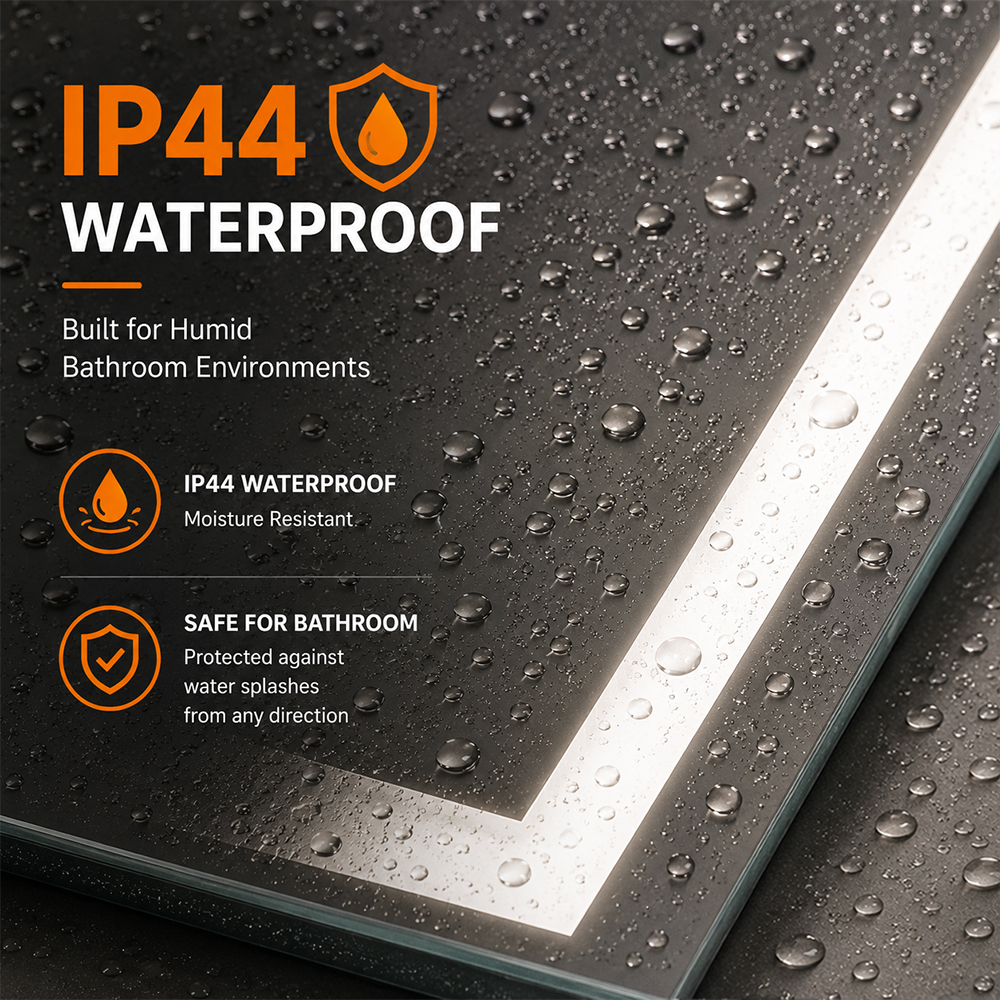
IP44 Waterproof LED Bathroom Mirror
I. What IP Rating Actually Measures
IP stands for Ingress Protection, defined under the international standard IEC 60529. It is a two-digit classification system that quantifies a product’s resistance to the intrusion of solid particles and liquids.
- First digit (0–6): Protection against solid particles — dust, debris, and contact by body parts
- Second digit (0–9): Protection against liquid ingress — dripping water, splashing, jets, and full immersion
For LED mirrors installed in bathroom environments, both digits carry real operational significance. A mirror rated IP2X may be acceptable in a dry bedroom; the same product installed above a vanity basin or inside a shower zone represents a safety and compliance failure.
| Digit | Refers To | Range |
|---|---|---|
| First | Solid particle / dust ingress protection | 0 (none) → 6 (dust-tight) |
| Second | Liquid ingress protection | 0 (none) → 9 (high-pressure steam) |
II. IP44, IP54, and IP65 — Technical Definitions
| Rating | Solid Protection | Liquid Protection | Practical Meaning |
|---|---|---|---|
| IP44 | Objects ≥1mm | Splashing from any direction | General bathroom zones away from direct water exposure |
| IP54 | Dust-partial (limited ingress) | Splashing from any direction | Improved dust resistance over IP44; same water protection level |
| IP65 | Dust-tight (zero ingress) | Low-pressure water jets from any direction | Full dust exclusion; withstands direct water jets — appropriate for high-humidity and splash-intensive zones |
The jump from IP44/IP54 to IP65 is significant on both digits. The liquid protection step from “4” (splashing) to “5” (water jets) reflects a meaningfully higher sealing standard — particularly relevant for mirrors positioned directly above basins or in open shower areas.
III. Bathroom Zone Classification & Corresponding IP Requirements
International electrical installation standards — including IEC 60364-7-701 — divide bathroom spaces into defined zones, each with minimum IP requirements for electrical fixtures.
| Zone | Location | Minimum IP Rating | Typical Mirror Placement |
|---|---|---|---|
| Zone 0 | Inside the bath or shower tray | IP67 minimum | Not applicable for mirrors |
| Zone 1 | Directly above bath/shower, up to 2.25m height | IP45 minimum (IP65 recommended) | Shower mirrors; open wet-room installations |
| Zone 2 | 0.6m horizontal radius beyond Zone 1 | IP44 minimum | Vanity mirrors above basins; standard wall placement |
| Outside Zones | General bathroom area beyond Zone 2 | IP21 minimum | Full-length mirrors; dressing area placements |
Most LED bathroom mirrors are installed in Zone 2 — above the vanity basin, within splashing distance but not in the direct shower stream. IP44 meets the technical minimum for this zone. However, IP65 provides a meaningful safety margin and is increasingly the baseline expectation in premium residential, hospitality, and commercial projects.
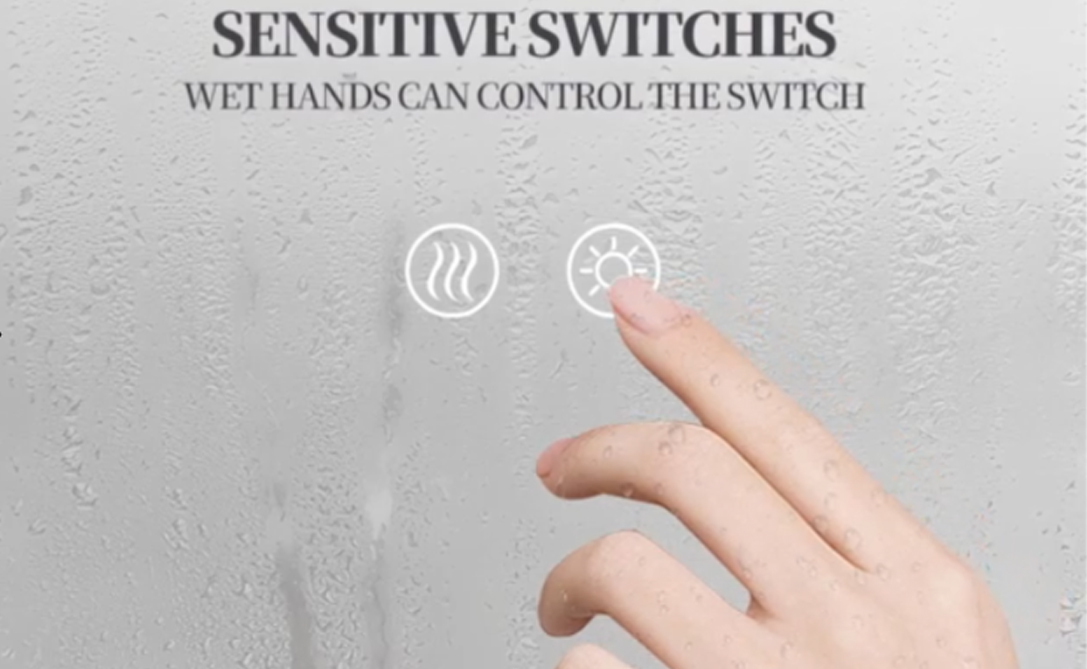
LED mirror waterproof appearance
IV. Why IP65 Has Become the De Facto Standard for Premium LED Mirrors
The minimum compliance threshold and the appropriate specification for a quality product are not the same thing. Several factors have driven IP65 toward becoming the expected baseline for premium-tier LED mirrors:
- Real-world installation variance: Mirrors are not always installed exactly where planned. Open-plan wet room designs frequently place mirrors closer to water sources than Zone 2 technically assumes. IP65 provides the margin to accommodate this.
- Steam and humidity accumulation: Even in Zone 2, sustained steam exposure creates a cumulative moisture environment. Dust-tight sealing prevents internal condensation buildup over time.
- Platform and market compliance: Major e-commerce platforms in North America, Europe, and Australia increasingly require IP65 as a listing prerequisite for bathroom electrical products.
- Liability exposure: An IP44-rated mirror installed in a high-humidity environment may be deemed non-compliant in the event of an electrical incident, transferring liability to the brand or distributor.
V. IP Rating Verification: Certification vs. Claimed Compliance
An IP rating printed on a spec sheet is not the same as a verified, tested certification. The distinction matters significantly in regulated markets.
- Self-declared ratings are common in lower-cost product tiers. No third-party testing has been conducted; these carry no legal standing in compliance audits or product liability proceedings.
- Third-party certified ratings are issued by accredited testing bodies — SGS, TÜV, Intertek, Bureau Veritas — following standardized ingress protection testing per IEC 60529. These are the only ratings that hold weight with platform compliance teams and regulatory authorities.
When evaluating a supplier, request the original test report — not just the certificate number. A legitimate IP65 certification will include the test date, the specific product model tested, the laboratory accreditation number, and the detailed test methodology.
VI. Commercial & Liability Implications of IP Rating Selection
Platform Listing Eligibility
Amazon, Wayfair, and major European retail platforms have progressively tightened electrical safety requirements for bathroom products. Specifying IP65 from the outset eliminates compliance review risk across current and future platform requirements.
Insurance and Product Liability
A claim arising from an electrical fault in an IP44-rated mirror installed in a high-humidity environment may be denied on the grounds that the product was not appropriately specified for its end use. IP65 certification substantially reduces this exposure.
Hospitality and Commercial Procurement
Hotel chains and commercial fit-out contractors routinely specify IP65 as a non-negotiable minimum for all bathroom electrical fixtures. Suppliers unable to provide verified IP65 certification are typically disqualified at the tender stage, regardless of price competitiveness.
VII. Frequently Asked Questions
Sourcing IP44 / IP65-Rated LED Mirrors for Your Brand or Project?
STANHOM has manufactured LED bathroom mirrors, smart mirrors, and mirror cabinets for over 17 years — supplying e-commerce brands, hotel groups, and apartment developers across North America, Europe, and Australia. 30+ certifications including verified IP44, CE, UL, SAA, and PSE. FBA-ready packaging and custom OEM available.


