
An LED infinity mirror is a decorative fixture built from two-way glass, an LED ring or strip, and a backing panel spaced apart to create a receding tunnel-of-light effect. Buyers should check the transmission-to-reflection ratio of the coated glass, LED chip pitch versus diffuser thickness to avoid visible dots, and frame depth (typically 45-70mm) for bracket and wall-cavity fit. Since forward light output is weak, task lighting needs a hybrid frontlit design. Best suited for hotel lobbies, spa walls, retail fitting rooms, and premium feature-wall installations.
An LED infinity mirror sells on visual drama, not on how well it lights a face for shaving or makeup. That is the real trade-off buyers need to settle before ordering samples: do you need a striking design piece for a lobby, spa, or feature wall, or do you need reliable task lighting for daily bathroom use. The two goals do not always line up, and mixing them up leads to returned stock or a disappointed hotel client.
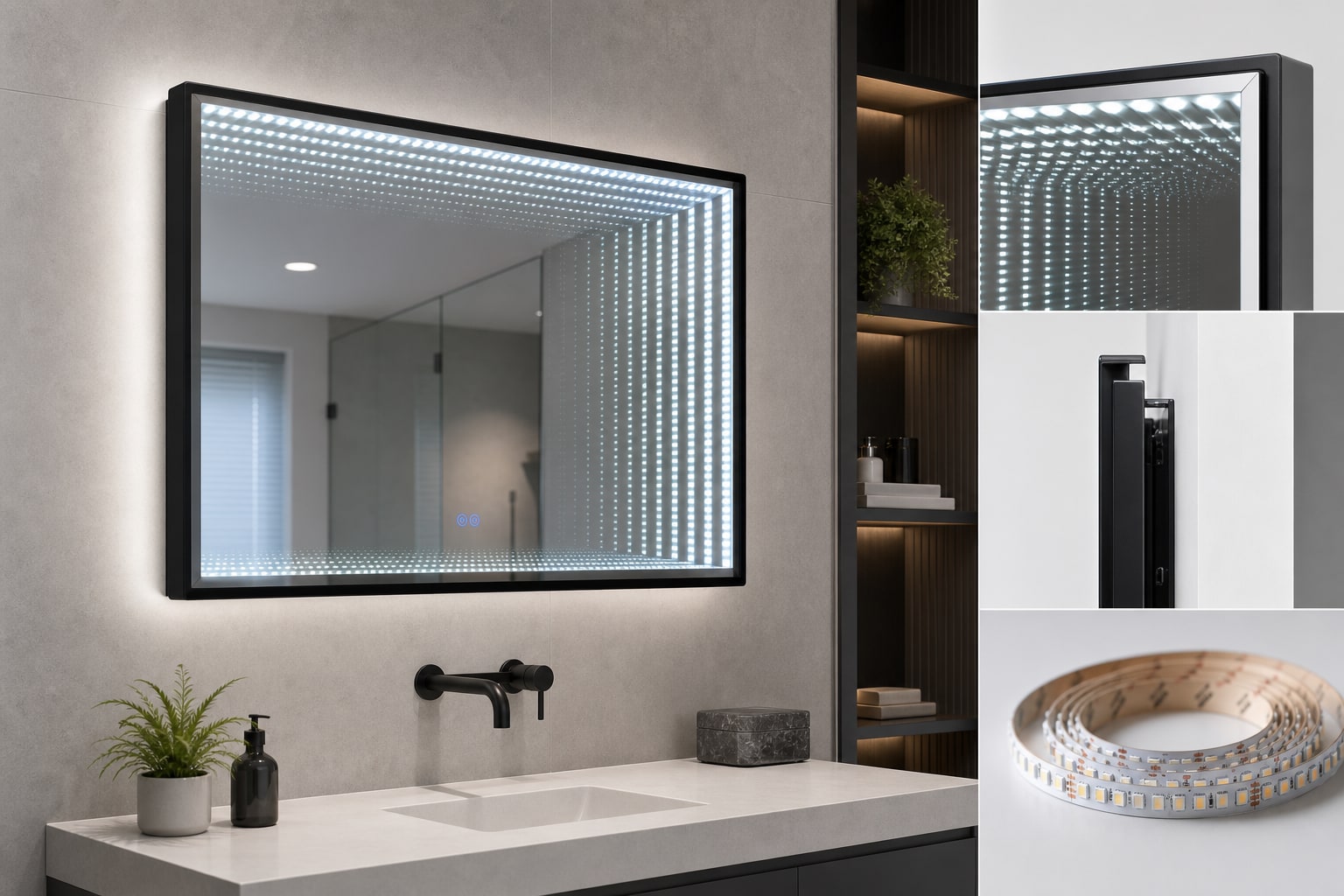
How the Infinity Light Effect Is Actually Built
An infinity mirror is not a single mirror. It is a sandwich of three layers: a front piece of two-way (semi-reflective) glass, a ring or strip of LEDs mounted behind it, and a solid backing panel a few centimeters further back.
Light from the LED strip bounces between the reflective coating on the front glass and the backing panel. Because the front glass reflects part of the light back and lets part of it through, each reflection creates a slightly dimmer, slightly further-back copy of the light source. Stack enough reflections and the eye reads it as a tunnel of light receding into the mirror.
The visual quality of that tunnel depends almost entirely on two things: the transmission-to-reflection ratio of the coated glass and the spacing between the LED strip and the backing panel. A coating that is too reflective kills the “infinity” look and just looks like a lit ring. A coating that lets too much light through looks washed out and shallow.
If you’re evaluating a supplier’s sample, don’t just check that the light turns on. Look at it in a dim room from a 45-degree angle and count how many visible reflection layers you can distinguish. Three to five clean layers is a reasonable benchmark for a mid-range product; fewer than that reads as flat.
Depth Effect vs Everyday Task Lighting
This is the trade-off that separates infinity mirrors from standard backlit or frontlit LED bathroom mirrors. A frontlit mirror throws light forward, onto the user’s face. An infinity mirror throws most of its light sideways and backward, into the reflection tunnel, and only a fraction escapes forward.
That means an infinity mirror on its own is a weak grooming light. If your buyer needs a mirror for a hotel guest bathroom where guests shave or apply makeup, an infinity-only design will underperform against a standard 3000-6500K frontlit LED mirror rated at 15-20W with even edge-to-edge brightness.
Some manufacturers solve this by combining an infinity ring around the perimeter with a separate frontlit or backlit panel behind the main glass. That hybrid design costs more and adds circuit complexity, but it answers the “looks good but is it usable” objection that project buyers raise most often.
If a hybrid unit is what the project calls for, ask for the lux reading at face distance (roughly 40cm) with the infinity ring on and the task light on separately, and again with both running together. That single spec tells you more about real usability than any marketing description.
Where the Infinity Effect Performs Well
Infinity mirrors earn their place in spaces where atmosphere matters more than functional lighting output. Hotel lobbies, spa reception walls, boutique retail fitting rooms, bar and restaurant feature walls, and high-end residential powder rooms are the strongest fits.
In these settings, the mirror is doing marketing and ambiance work. A guest photographing a lobby feature wall, or a fitting room mirror that makes a boutique feel premium, justifies the extra unit cost and the narrower lighting output.
Guest bathroom vanities are a mixed case. A small ensuite bathroom where the mirror is the only light source over the sink is a poor match for a pure infinity design. A larger bathroom with separate ceiling or wall lighting, where the mirror is decorative rather than the primary light, works better.
Retail and showroom applications deserve a separate note. Fitting room infinity mirrors get heavy daily use and frequent cleaning with glass cleaner. Coating durability matters more here than in a low-traffic residential install, so ask specifically about coating wear resistance rather than assuming a residential-grade sample will hold up under commercial cleaning schedules.
Frame Depth and Wall Mounting Requirements
Standard LED mirrors mount close to the wall, often within 30-40mm of frame depth. Infinity mirrors need physical space between the front glass and the backing panel for the reflection tunnel to form, which typically pushes total unit depth to 45-70mm depending on how many reflection layers the design targets.
That extra depth changes two things procurement teams often overlook. First, wall-mounted brackets need to support a heavier, deeper unit without sagging over time, so ask for the bracket load rating rather than assuming it matches a flat mirror’s hardware. Second, recessed or semi-recessed installs (common in hotel corridors and elevator lobbies) need the wall cavity depth confirmed before the mirror ships, not after it arrives on site.
For large-format infinity mirror walls, some projects split the piece into panels rather than one continuous sheet of two-way glass. Panel joints are visible up close, so if the design calls for a single uninterrupted tunnel effect across a wide wall, confirm the maximum single-panel size the factory can produce and ship safely before committing to the layout.
LED Strip Spacing and Visible Dot Risk
The most common quality complaint with infinity mirrors is visible individual LED dots rather than a smooth ring or line of light. This happens when the LED chip spacing on the strip is too wide relative to the diffusion material covering it, or when the diffuser itself is too thin or too clear.
Ask for the LED spacing in millimeters (chip pitch) and compare it against the diffuser thickness. As a rough guide, wider chip spacing needs a thicker or more heavily frosted diffuser to blend the points of light into a continuous glow. A supplier who can’t answer this in specific numbers is likely not controlling this variable carefully.
Dimming behavior is worth checking too. Infinity effects tend to look best at lower brightness settings, where the reflection layers are distinct rather than blown out. If the unit doesn’t dim smoothly, or flickers at low settings, the visual effect the buyer is paying for won’t show up correctly once installed.
| Mirror Type | Primary Purpose | Task Lighting Quality | Best Application |
|---|---|---|---|
| LED Infinity Mirror | Decorative depth effect | Low to moderate | Lobbies, feature walls, retail displays |
| Backlit LED Mirror | Ambient perimeter glow | Moderate | Bedrooms, guest bathrooms with side lighting |
| Frontlit LED Mirror | Direct facial illumination | High | Hotel vanities, salon stations, shaving/makeup use |
| Hybrid Infinity + Frontlit | Decorative effect plus usable light | Moderate to high | Premium hotel bathrooms, boutique fitting rooms |
Power, Control, and Project Wiring Fit
Infinity mirrors with multiple LED layers or hybrid task lighting draw more current than a simple frontlit mirror, especially at larger sizes. A 1200mm infinity feature mirror with a secondary task ring can pull noticeably more wattage than a same-size flat backlit unit, which affects driver sizing and circuit planning on hotel or commercial projects.
Confirm the input voltage range and driver type before finalizing a bulk order, particularly for projects spanning multiple countries with different mains voltage standards. A driver rated only for 220-240V will need swapping or a separate transformer for 110-120V markets, and that detail is easy to miss when a sample was tested only in one region.
Touch controls generally work fine on infinity mirrors since the control zone sits on the frame rather than on the glowing glass area. Motion sensors are less common on this product type since the “always visible” tunnel effect is often part of the design intent, so confirm with your client whether they actually want the light to switch off automatically or stay on as a static feature.
Frequently Asked Questions
Why does an LED infinity mirror perform poorly as a shaving or makeup light?
Because most of its light travels sideways and backward into the reflection tunnel rather than forward onto the user’s face. A pure infinity design only lets a fraction of output escape toward the mirror surface, so it underperforms against a standard 3000-6500K frontlit mirror running 15-20W with even edge-to-edge brightness. For task use, buyers need a hybrid or frontlit alternative instead.
How many visible reflection layers should a good infinity mirror sample show?
Three to five clean, distinguishable layers is a reasonable benchmark for a mid-range unit when viewed in a dim room from a 45-degree angle. Fewer layers usually means the front glass coating’s transmission-to-reflection ratio is off, either too reflective to create depth or too transparent, which reads as flat or washed out rather than a true tunnel effect.
What’s the difference between an infinity mirror and a hybrid infinity plus frontlit mirror?
A pure infinity mirror uses a single LED ring behind two-way glass purely for the depth effect, with weak forward light output. A hybrid design adds a separate frontlit or backlit panel behind the main glass for usable task lighting, at added cost and circuit complexity. Hybrids suit premium hotel bathrooms and fitting rooms where both looks and function matter.
Why do infinity mirrors need more wall or frame depth than standard LED mirrors?
The reflection tunnel needs physical space between the front glass and backing panel to form multiple light layers, pushing total unit depth to roughly 45-70mm compared to 30-40mm for standard flat LED mirrors. This affects bracket load ratings and recessed wall cavity depth, so confirm both before ordering rather than discovering a fit problem on installation day.
How can buyers avoid visible LED dots instead of a smooth glowing ring?
Ask the supplier for the exact LED chip pitch in millimeters and compare it against the diffuser thickness and frosting level. Wider chip spacing needs a thicker, more heavily frosted diffuser to blend individual points into continuous glow. A supplier who can’t give specific numbers for both is unlikely to be controlling this variable, and dot visibility will show up after installation.
Looking to source LED infinity mirrors for a hotel, retail, or residential project?
STANHOM is a Chinese manufacturer of LED Mirrors and Smart Mirrors, supporting OEM, ODM, private-label, and wholesale orders. Our infinity and hybrid mirror designs are available with CE, RoHS, REACH compliance and IP-rated options for bathroom installs.
Visit stanhom.com to review specifications and discuss your project requirements.


