
The disadvantages of LED mirrors include higher unit cost, added electrical failure points, and greater sensitivity to bathroom humidity compared to plain glass mirrors. Key components—LED drivers, chip strips, touch sensors, and anti-fog pads—can fail independently, and many are bonded or potted, making repairs harder than a simple bulb swap. Buyers should check IP ratings by component, driver enclosure sealing, and lumen maintenance data before ordering. These trade-offs matter most for hotel refurbishments, rental properties, and private-label bathroom mirror programs requiring predictable after-sales support.
- Higher Unit Cost Compared to Standard Bathroom Mirrors
- Electrical Components Create Failure Points a Passive Mirror Never Has
- Bathroom Humidity Puts More Stress on LED Mirrors Than on Plain Glass
- Repairing a Failed Unit Is Not as Simple as Swapping a Bulb
- Touch and Sensor Controls Can Behave Less Predictably Than a Wall Switch
- Light Output and Color Consistency Change Over the Mirror’s Lifespan
- Frequently Asked Questions
LED mirrors carry real trade-offs that plain glass mirrors do not. They add electrical components that can fail, they cost more to produce and repair, they are more sensitive to bathroom humidity, and once installed, some faults are harder to fix than simply replacing a bulb. None of this rules out LED mirrors for a project or a private-label line — but it does change how you spec the product, negotiate warranty terms, and plan after-sales support.
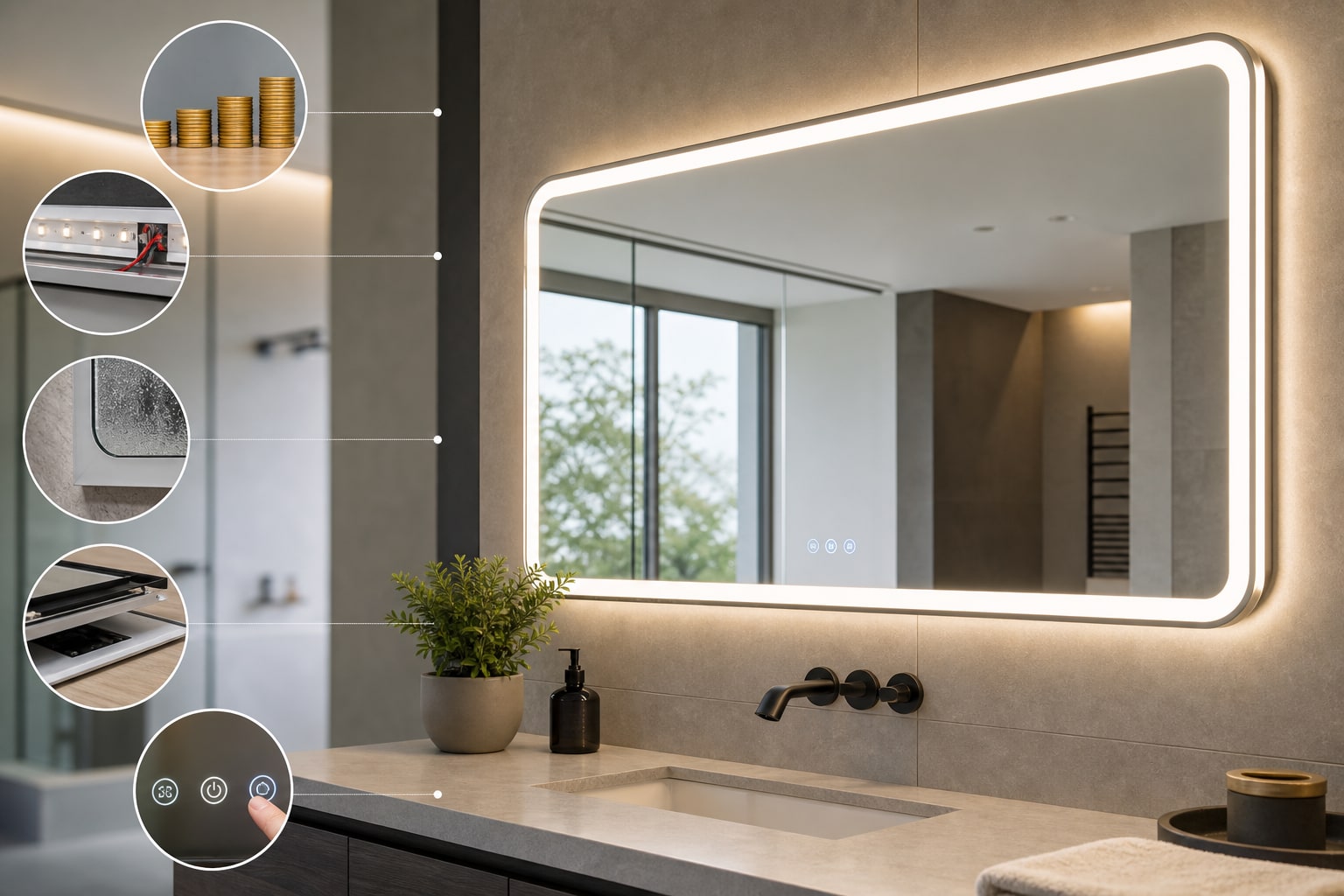
Higher Unit Cost Compared to Standard Bathroom Mirrors
A plain silvered mirror has one real cost driver: the glass and the backing. An LED mirror adds a driver, an LED strip or module, wiring, a touch or sensor control board, and often anti-fog film or a defogger pad. Each of these is a line item on the bill of materials, and each one adds assembly time.
For a hotel refurbishment or a private-label catalog running hundreds of units, this cost difference compounds quickly. A $3 per-unit gap between a basic LED mirror and a feature-rich one can turn into a five-figure swing across a large order.
Before locking in a spec, break down the BOM with your supplier line by line. Ask which features are driving the price — dimming, CCT adjustment, Bluetooth, defog — and decide which ones your end buyer will actually notice. Cutting one feature that adds cost but little perceived value is often the easiest way to protect margin without downgrading the product.
Electrical Components Create Failure Points a Passive Mirror Never Has
A glass mirror rarely fails outside of physical damage. An LED mirror can fail through the driver, the LED chips, the PCB connections, or the touch sensor — any one of these can take the whole light function down even if the mirror glass itself is fine.
This matters most in high-turnover environments like hotels and rental properties, where a dark mirror generates a maintenance ticket regardless of which component actually failed.
| Component | Typical Failure Mode | What to Check Before Ordering |
|---|---|---|
| LED Driver | Flickering, dimming failure, no output | Driver brand, rated lifespan, whether it is replaceable without cutting the mirror open |
| LED Strip/Chip | Uneven light, dark spots, color shift | Chip brand, binning consistency, lumen maintenance data |
| Touch Sensor Board | Unresponsive touch, false triggers | Sensor type, sensitivity to voltage fluctuation and moisture |
| Anti-Fog Pad | Reduced heat output, patchy defogging | Pad wattage, adhesive quality, whether it is field-replaceable |
Ask for the warranty terms on each component separately, not just a blanket “1-year warranty” on the finished mirror. A driver failure at month 13 is a different conversation than a glass defect at month 2, and your supplier’s warranty language should reflect that distinction.
Bathroom Humidity Puts More Stress on LED Mirrors Than on Plain Glass
A standard mirror handles steam and splashing without any functional risk. An LED mirror has electronics sitting a few centimeters from the water source, and moisture ingress is one of the more common causes of early failure in this category.
IP ratings help, but the rating only means something if you know what part of the mirror it covers. An IP44 rating on the light strip does not tell you anything about the driver compartment, and a driver mounted in an open enclosure behind the mirror can still corrode even if the LED module itself is sealed properly.
When comparing samples, ask where the driver sits relative to the mirror body and how the enclosure is sealed. A driver mounted inside a sealed compartment with a gasket is a stronger design than one simply zip-tied behind the glass with exposed wiring.
Repairing a Failed Unit Is Not as Simple as Swapping a Bulb
Older bathroom light fixtures used replaceable bulbs. Most LED mirrors don’t work that way. The LED strip is often bonded directly to the mirror backing or potted with silicone, which means a failed strip usually means replacing the entire light module — or the whole mirror, depending on how the unit was assembled.
This is a real disadvantage for after-sales support. A property manager dealing with 200 installed units doesn’t want to hear that a $40 mirror needs a full replacement because one LED segment died.
Before committing to a supplier, find out whether the driver and LED module are separable components that a local electrician can swap, or whether the design requires shipping a replacement unit from the factory. For large installations, it’s worth negotiating a spare parts allocation — a small percentage of drivers and control boards shipped alongside the main order — so minor failures don’t turn into shipping delays six months into the warranty period.
Touch and Sensor Controls Can Behave Less Predictably Than a Wall Switch
A mechanical switch either works or it doesn’t, and the failure is obvious. Capacitive touch sensors are more elegant, but they can be affected by voltage fluctuation, humidity buildup on the glass surface, and even mineral residue from hard water splashing near the control point.
The result is a mirror that sometimes turns on by itself, or one that needs two or three taps to respond. For a private-label consumer product, this is a minor annoyance. For a hotel bathroom where staff and guests expect the light to work every time, it becomes a support call.
If reliability matters more than a premium feel, a physical push-button or a simple slide switch is a lower-risk choice than touch controls — particularly for budget hotel tiers or rental units where maintenance staff turnover is high and troubleshooting time is limited.
Light Output and Color Consistency Change Over the Mirror’s Lifespan
LED chips lose brightness gradually, and cheaper chips lose it faster. A mirror rated at 4000K on day one can visibly shift color temperature after a year or two of daily use, especially if the diffuser layer starts to yellow from heat exposure.
This matters more for LED mirrors than for most other lighting products because the mirror is a task-lighting tool — buyers use it for shaving, makeup application, and skin inspection, where consistent, accurate light matters.
Lumen maintenance data (how much brightness the chip retains at a given number of operating hours) is a better indicator of long-term quality than the initial lux reading on a spec sheet. If your supplier can’t provide this data, ask for the chip brand and cross-check its published depreciation curve independently.
Frequently Asked Questions
What is the biggest disadvantage of LED mirrors compared to plain glass mirrors?
The main disadvantage is added failure risk from electrical components. Plain glass mirrors rarely fail outside physical damage, but an LED mirror can go dark due to a driver fault, LED chip degradation, or a touch sensor malfunction, even when the glass itself is fine. This creates ongoing maintenance exposure that a passive mirror never carries, especially across large hotel or rental portfolios.
Can a failed LED mirror be repaired, or does the whole unit need replacing?
It depends on the construction. Many LED strips are bonded or silicone-potted to the mirror backing, so a failed segment often means replacing the whole light module or unit rather than a simple bulb swap. Before ordering, ask whether the driver and LED module are separable and field-replaceable, or whether repairs require shipping a new unit from the factory.
Why do touch controls on LED mirrors sometimes behave unpredictably?
Capacitive touch sensors can misfire due to voltage fluctuation, condensation buildup, or mineral residue from hard water near the control point, causing self-triggering or delayed response. This is a minor nuisance for private-label consumer products but becomes a real support issue in hotels. A physical push-button or slide switch is a lower-risk alternative where staff turnover limits troubleshooting time.
How does humidity affect the long-term reliability of LED mirrors?
Bathroom humidity accelerates corrosion in driver compartments and connectors sitting close to water sources, making moisture ingress one of the most common early failure causes. An IP rating on the LED strip doesn’t guarantee protection for the driver itself, so buyers should confirm where the driver sits and whether its enclosure is gasket-sealed rather than simply exposed behind the glass.
STANHOM manufactures LED Mirrors and Smart Mirrors for importers, distributors, and hospitality procurement teams, with OEM and ODM support for private-label programs. Our production covers CE, RoHS, and REACH compliance, along with IP-rated options built for humid bathroom environments.
If you’re weighing these trade-offs against a specific project, we can walk through component options, driver placement, and warranty terms before you finalize a spec.


